Learn Persian (Farsi) with Movies & TV Shows
Why Immersion Is Important
Professional language learners and teachers consistently recommend a strategy: surround yourself with the language. Don’t wait for classes to pick up the pace – make it a habit. Think about it – you’re already consuming content all the time! Scrolling through social media, watching your favorite shows, or even listening to music – these are all fantastic ways to get exposed to the language.
The key is to make language learning a daily practice. It doesn’t have to be a massive commitment – it’s about weaving it into your routine. It’s not about intense study; it’s about consistent exposure.
Let’s face it: our brains are wired for engagement. The more you’re immersed, the more easily you’ll absorb the language. Seriously, anywhere you can – while you’re scrolling, while you’re commuting, while you’re relaxing – expose yourself to the language. Start with simple phrases. The more you hear it, the easier it becomes to recall. Don’t be afraid to just listen. Even a little bit of exposure can be incredibly beneficial. It’s all about building a foundation.
Variety is key! Don’t limit yourself to just one source. Explore different types of media – social media, movies, music—whatever feels appealing. I have already spoken about learning Persian with easy books, YouTube videos and Instagram, and today we are going to focus on movies and TV shows.
Why Movies & TV Shows
Why do we use movies and TV shows? Well, learning a language isn’t just about memorizing vocabulary lists. It’s about understanding a culture, a way of thinking, and a whole world of storytelling. Movies and TV shows offer a direct, immersive experience of these things.
When you watch, you’re not just passively absorbing dialogue. You’re watching context. Persian, like many languages, uses metaphors and imagery. These moments help you grasp nuances of meaning before you dive into a dictionary. It’s like building a mental model. You see the situation, the characters’ emotions, and the cultural background, all at the same time. This contextual understanding makes the language much more accessible.
Also, they give you an opportunity to learn gestures (especially in comedies where they are exaggerated and easier to spot), interjections and other emotionally charged or situational phrases that will make your speech richer and help you sound more natural.
Finally, movies and TV shows are a brilliant way to get to know and learn to distinguish all kinds of accents (and in Iran there are many).
I love using authentic video materials in class teaching Persian. If you struggling with learning Persian by yourself, I am here to help. Find all the information on how to book an online class with me here.
How To Use Movies & TV Shows
Now, let’s get practical. How do you use movies and TV series to improve your Persian? Start with the vocabulary that you already know. Learning a language and especially vocab is all about repetition. The more often you see the word, the easier it is to memorize it. The more contexts you see a familiar word in, the deeper becomes your understanding of the word and the more fluently and correctly you can use it in various contexts. Don`t push yourself to necessarily learn something new from what you watch. Remember – revising what you already know is just another phase of learning.
But of course, learning some new words and idioms can be useful too, especially those casual ones that are impossible to learn from a textbook. Hear a word that characters keep using? Why not look it up? Just make sure not to overdo. Do you absolutely need to find out the meaning of the word to understand the plot? Then go for it, otherwise, just keep watching.
I find it really helpful to pause and repeat key phrases. Repeating them out loud, even just to yourself, helps solidify the meaning and also polish your pronunciation which can be tricky sometimes because of the difference between the written and spoken language.
Adding a little bit of acting won`t hurt either. When you see a character express frustration, try to mimic that subtle tone of voice. It’s a great way to get your ear accustomed to the sound system of the language. You don’t need to be perfect, just try to get a feel for the rhythm and intonation.
Where To Watch
If you are still a beginner, but already want to start watching movies, I recommend imvbox where you can find lots of Iranian movies with subtitles in various languages (yes, they are not limited to English).
If you can survive without English subtitles but wouldn`t mind having at least Persian subtitles, I recommend you to use an Iranian streaming service like Filimo or Namava. Then look for the ones with closed captions (there will be a sign on the movie icon), and here you go – the movie will be streamed with Persian subtitles!
If you have improved in Persian enough to understand the story without subtitles, then the easiest way would be to search them on YouTube.
If you can`t find a TV show anywhere else, you can try an Iranian platform Telewebion with a huge TV archive.
Another website that I use to watch Iranian movies when outside Iran is FarsiLand, but don`t expect any subtitles there.
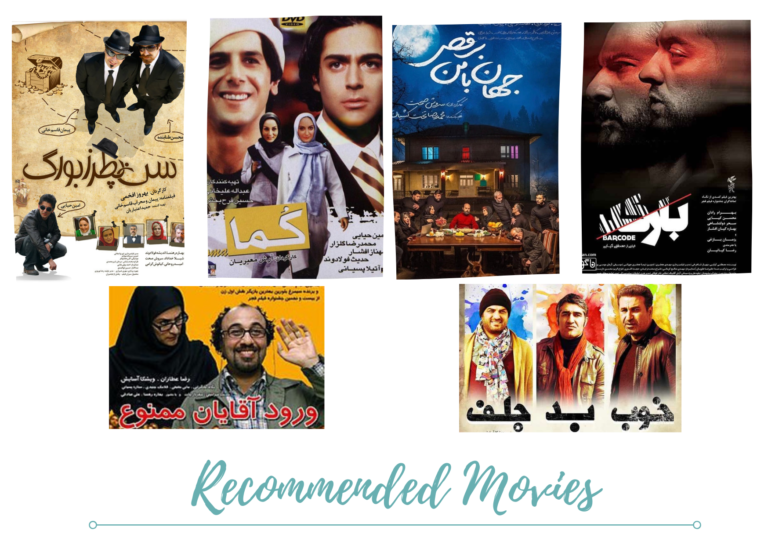
Now, let’s start with movies. Movies give you a full, complete story in just a couple of hours. That makes it easier to follow the plot, even if your language skills aren’t perfect yet. And because you watch a whole story in one sitting, you hear the same characters speak again and again. Their voices, accents, and expressions start to feel familiar. This helps your brain pick up patterns faster.
Movies usually have higher production quality. Better sound. Better acting. And that makes it easier to understand speech and learn how real conversations flow. Watching movies teaches you rhythm, tone, and culture, all in one experience.
Finally, it`s just easier to find subtitles for movies, just in case you are afraid to miss something important.
Award-winning dramas and Iranian classics that have received international recognition may seem more exciting to watch but I wouldn`t start with them. They have complicated plots, are rather dialogue-oriented and sometimes lack a proper ending, so they can be tricky to figure out even with subtitles.
I think it`s best to start with comedies. They usually have very simple story plots, easy and fun to watch. Also, Iranian comedies use a lot of exaggeration, gestures and mimics, so you can have a good laugh even if you miss some verbal jokes. I believe understanding a joke in a foreign language gives the best satisfaction in the language-learning process, don`t you agree?
Here are a few comedies to start with.
- A romantic comedy Coma (2004) featuring the movie star of the time – Mohammad-Reza Golzar.
- Saint-Petersburg (2010), a comedy written by two brothers, two brilliant comedy screenwriters, Peyman and Mehrab Ghasemkhani.
- No Men Allowed (2011) ورود آقایان ممنوع
This is a hilarious romantic comedy about a strict women-only high school where men are totally banned. But one day an exception is made for this rule… A bunch of brilliant actors star in this movie, and it`s also a great opportunity to see what an Iranian high school looks like from the inside.
- Barcode (2016), a comedy that turns into a social drama.
- The Good, the Bad, the Corny (خوب، بد، جلف) (2017), Two goofball actors become involved in a real criminal situation as they train with a tough cop for a role.
- Jahan, Dance with Me (2019) جهان با من برقص
A few friends visit their dying friend in his country house. But don`t expect a drama. Filmmaker Sorush Sehat managed to combine a tragic story with some absolutely hilarious characters and scenes. In this movie, he explores relationships between friends and lovers.
If for whatever reason you prefer to watch dramas, here is a list of movies from the past decade or so that are easier to understand.
- Sorkhpoost (سرخپوست)
- Ehtemal-e Baran-ye Asidi (احتمال باران اسیدی)
- Mahi-o Gorbe (ماهی و گربه)
- Ghaside-ye Gav-e Sefid (قصیده گاو سفید)
- Dar Donya-ye To Saat Chand Ast? (در دنیای تو ساعت چند است)
- Abad-o Yek Ruz (ابد و یک روز)
- Bomb: Yek Asheghaneh (بمب یک عاشقانه)
- Barf Ruye Kajha (برف روی کاجها)
- Tehran: Shahr-e Eshgh (تهران شهر عشق)
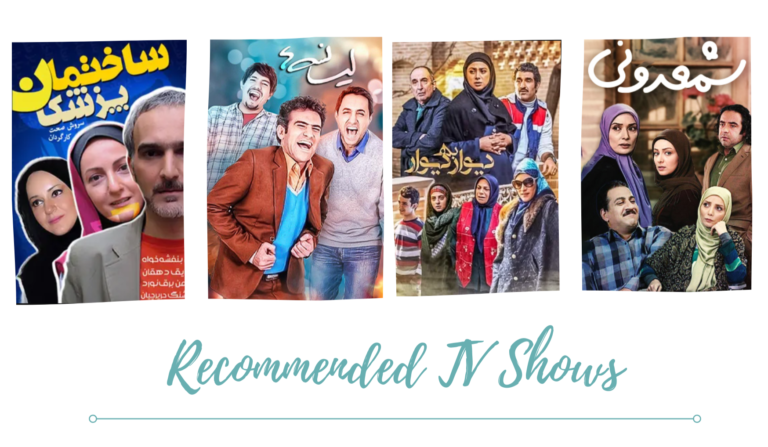
But what about TV shows? TV series are amazing for language learning because they give you time. Lots of time. You follow the same characters for many episodes. That means you hear their voices again and again. You get used to their speaking style, their speed, their accent. And that repetition is perfect for building confidence. Even if you miss something at first, you’ll hear it again in the next episode.
TV shows provide a much richer, more immersive experience. A TV show has more time to explore different situations, emotions, and vocabulary. You see how people talk at work, at home, during conflicts, celebrations—everything.
TV shows also make the learning process easier because the story moves slowly. You don’t need to understand every detail right away. The plot develops gradually, so your brain can relax and catch up. And because each episode ends with a little hook, you actually want to watch more. That motivation keeps you going. Plus, episodes are shorter than movies, so it’s easier to fit them into your day. A quick 30 or 40-minute episode can still teach you tons. TV series turn language practice into a habit, and that’s where real progress happens.
For TV shows I would again recommend comedies. Here are some of my favorite ones.
- Sakhteman Pezeshkan (The Doctors’ Building) ساختمان پزشکان
This show follows a slightly chaotic psychologist whose life is anything but organized, and he constantly gets pulled into hilarious, awkward situations. My favorite character in it is his secretary Khanoom-e Shirzad though who mixes everything up all the time, including different, similar sounding words like ‘azhans’ (taxi agency) and ‘oorzhans’ (ambulance), ‘atash-neshan’ (firefighter) and ‘atash-feshan’ (volcano). When I was just learning Persian, I could relate to her a lot.
- Lisanséha (The Graduates) لیسانسهها
Lisanséha is about three young guys who’ve got their bachelor’s degrees but are still trying to figure out what to do with their lives. Each one has his own set of funny, sometimes frustrating challenges — whether it’s finding a job, dealing with family expectations, navigating relationships, or just surviving adulthood. It’s a light, character‑driven comedy that feels super real if you’ve ever been in that “what now?” phase.
- Divar Be Divar (Side by Side) دیوار به دیوار
Divar Be Divar brings together several families who, because of financial problems, end up living under the same roof in a house. With completely different personalities and lifestyles squeezed into one shared space, the clash of characters leads to nonstop comedic moments. It’s all about forced community, unexpected friendships, and the chaos of too many people living way too close.
- Shamdooni (Pelargoniums) شمعدونی
An absolutely adorable family sitcom.
My biggest tip to all Persian learners is ‘Embrace the immersion!’ Find Persian-related things that you enjoy and take it outside the classroom or textbook into your hobbies and entertainment, and into your life.
Let me know in the comments – what’s your go-to method for getting immersed in a new language?
If you have any questions about learning Persian, don`t hesitate to ask me in comments. I’d be delighted to help you out and answer them or even write a post about it.
YOU MIGHT ALSO LIKE

You May Also Like
Iranian Cinema: An Overview of Fajr Film Festival
January 29, 2018